


In a non-professional environment, varicose veins of the lower extremities are considered "feminine."This is wrong.Men also suffer from varicose veins of the superficial veins of the lower extremities.Data from large statistical studies confirm this.The predominance of half the population in public hospitals only indicates that women focus on varicose veins, while men do not.Most women who seek the help of a general surgeon or a phlebologist have, in addition to medical, cosmetic purposes.For men, as a rule, they are of no interest.
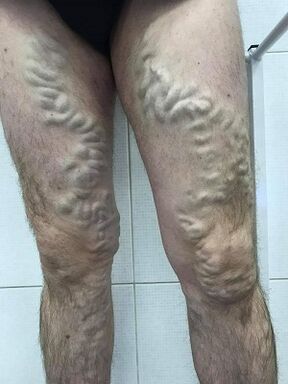
Thus, in our country as a whole, the “male” form of chronic venous diseases is characterized by a late presentation.As they say, “until the thunder falls, a man will not cross himself”…
"Male" risk factors for varicose veins
It is generally accepted that the true cause of varicose veins is still unknown.Risk factors include hereditary predisposition and lifestyle.These risk factors are the same for men and women.
The main ones:
- sedentary lifestyle;
- work associated with long periods of forced standing and sitting;
- discrepancy between eating habits and actual energy costs, leading to obesity;
- smoking;
- Heavy physical work associated with lifting and carrying heavy objects.
- Sports that involve weight lifting.

Causes of severe forms of varicose veins in men.
At the initial stage, the development of varicose veins in men and women is the same.The disease progresses according to the same principles and with the same stages.The reason for the most serious forms of varicose veins when it comes to seeing a phlebologist in men is precisely the late presentation.Men, as a rule, do not care about the aesthetic component.There is no pain in varicose veins in the early stages of the disease, so most men do not consider it necessary to seek advice and help.As pain and swelling appear, men just as firmly ignore these symptoms and show miracles of unconsciousness.The reason for this behavior is the lack of information.The collapse of the dispensary system and the lack of medical information for the population leads to a low level of literacy among the male population about the possible harm of varicose veins.
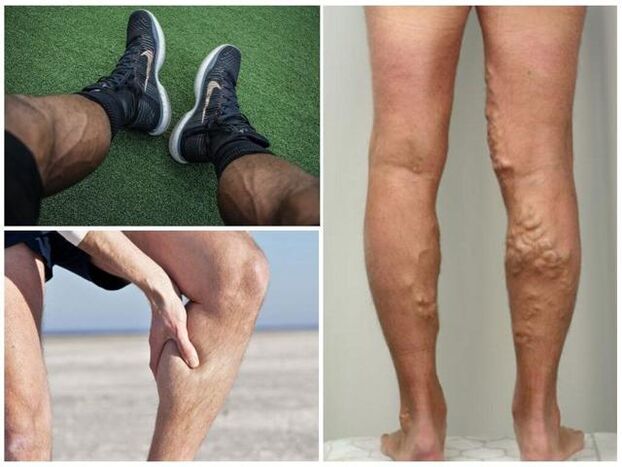
Another factor that prevents the male population from timely turning to a phlebologist is the unwillingness to wear "female" compression stockings.This is also a consequence of medical illiteracy and is largely the fault of medical workers and not the population.
The lack of long-term treatment leads to the fact that by the time a man turns to a phlebologist or general surgeon, he already has:
- Advanced major varicose veins with signs of severe chronic venous insufficiency,
- thrombophlebitis or venous thrombosis
- trophic ulcer of venous origin
- varicose vein bleeding
To avoid these complications, a modern and timely diagnosis is necessary.
Diagnosis of varicose veins in men.
The optimal solution for men with varicose vein symptoms is to contact a competent phlebologist.Ultrasonic examination of blood vessels at the time of treatment is a mandatory component of the consultation with a phlebologist!It is advisable that the ultrasound of the veins be performed not by an external doctor (no matter how qualified), but rather by the phlebologist you contacted personally.The doctor who undertakes to advise you is responsible for both the correct diagnosis and the development of a treatment strategy.
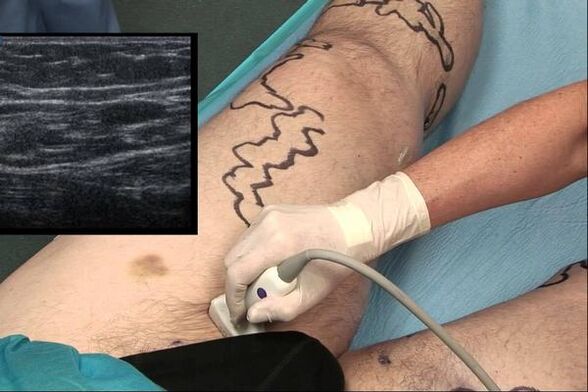
Ultrasonic angioexploration in duplex and triplex modes (ultrasound of veins) is the basis for the diagnosis and treatment of venous diseases.Therefore, this test must be carried out by the doctor who will advise, treat or operate you.Ultrasound of veins should be performed standing.For patients whose health does not allow ultrasound to be performed in an upright position, the examination can be performed in a lying position with effort, but its diagnostic value will be lower.Especially when it comes to diagnosing deep vein thrombosis.After interviewing the patient, examination, palpation and ultrasound of the veins, the phlebologist must write his report, which includes a brief history of the disease, diagnosis and recommendations.It is mandatory to write an ultrasound angioscanning protocol indicating the date of the study.If necessary (complex cases, congenital malformations, consequences of massive deep vein thrombosis), the doctor recommends additional clarifying studies (magnetic resonance venography, X-ray angiography or others).
Only this approach meets modern European standards. The expert examination will not last more than half an hour and you will receive sufficient information about the venous system of your lower extremities.
Consultation with a phlebologist is absolutely safe and does not involve any traumatic examinations or procedures.No special preparation required. Timely diagnosis is extremely important to choose modern and effective treatment that prevents complications and disease progression.
Symptoms of varicose veins in men.
Every patient should pay attention to these signs:
- The appearance of varicose veins that protrude from the skin when standing.
- Feeling of heaviness in the legs, especially at the end of the workday.
- Unpleasant sensations throughout the course of varicose veins.
- Pain along the path of varicose veins, especially at the end of the workday.
- Swelling in the legs and feet area.The first symptoms are that the elastic of the sock leaves a clearly visible mark and the usual shoes become tight.
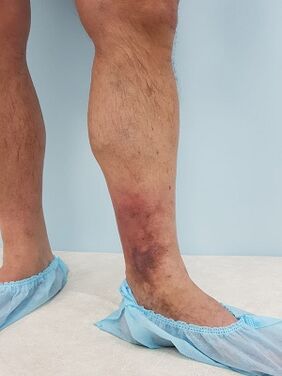
- Changes in skin color (appearance of brown or bluish pigmentation).
- Trophic ulcer in the lower third of the leg along the inner surface.
Treatment of varicose veins in men.
For most people, there is now a modern, high-quality treatment for varicose veins.Professional specialists work only according to the protocols recommended by the Association of Phlebologists and in accordance with European recommendations.Clinics and medical centers use modern equipment for ultrasound angioscanography and laser treatment of varicose veins.
The main methods of varicose vein treatment used by specialists:
- Thermoobliteration (laser and radiofrequency).
- Miniphlebectomy.
- Sclerotherapy.
- A combination of these techniques.
Treatment in medical centers is completely outpatient, without anesthesia, spinal anesthesia or hospitalization.All necessary medical documentation is issued (consultation with a phlebologist surgeon, ultrasound angioscanning protocol, discharge summary with recommendations, certificate of temporary disability, documents for tax deductions).
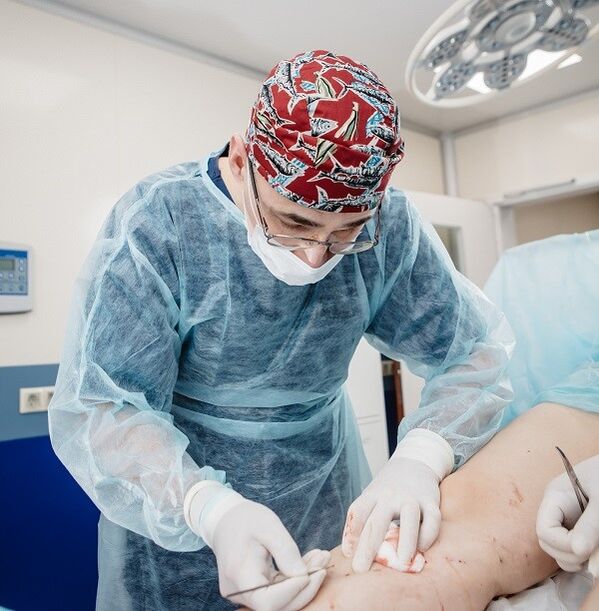
Many patients have already appreciated the benefits of innovative methods for treating varicose veins.It should be noted that all of them depend on the operator.That is, the success of the treatment depends not only on the modernity and high cost of the equipment, but also on the operator, that is, the doctor who works on it.Specialists have extensive experience in ultrasound diagnosis of diseases of the lower extremities (all specialists have valid ultrasound diagnostic certificates), as well as extensive experience in operations on the veins of the lower extremities and thermal (laser, radiofrequency) obliteration of varicose veins.